This is our primary service line. We engineer vibration isolation and seismic restraint from the problem down — equipment, structure, utilities, clearances and performance criteria — so isolators, restraints, frames and anchors are designed as one coordinated system for facilities across NJ & NY. Choosing a mount is the last step, not the first.

Equipment weight, operating frequency, expected deflection, structural stiffness, connected piping or ductwork, attachment conditions and clearance all affect how a system performs once installed. When any of those is assumed rather than evaluated, an isolator that looks correct on a submittal can underperform in the field — or short out against a restraint or rigid pipe connection.
Vibration isolation and seismic restraint address different operating conditions — and in many applications the two must be designed together. Isolation reduces vibration transfer during normal operation; restraint limits excessive movement during a seismic event. A restraint should limit damaging movement without interfering with the isolator during normal operation.

Mounts and pads that reduce vibration transfer, plus damping treatments that dissipate resonant energy — evaluated against your source, equipment and transmission paths.
For heavy equipment and low-frequency vibration requiring greater static deflection, selected on loads, operating frequencies, deflection, stability and installation constraints.
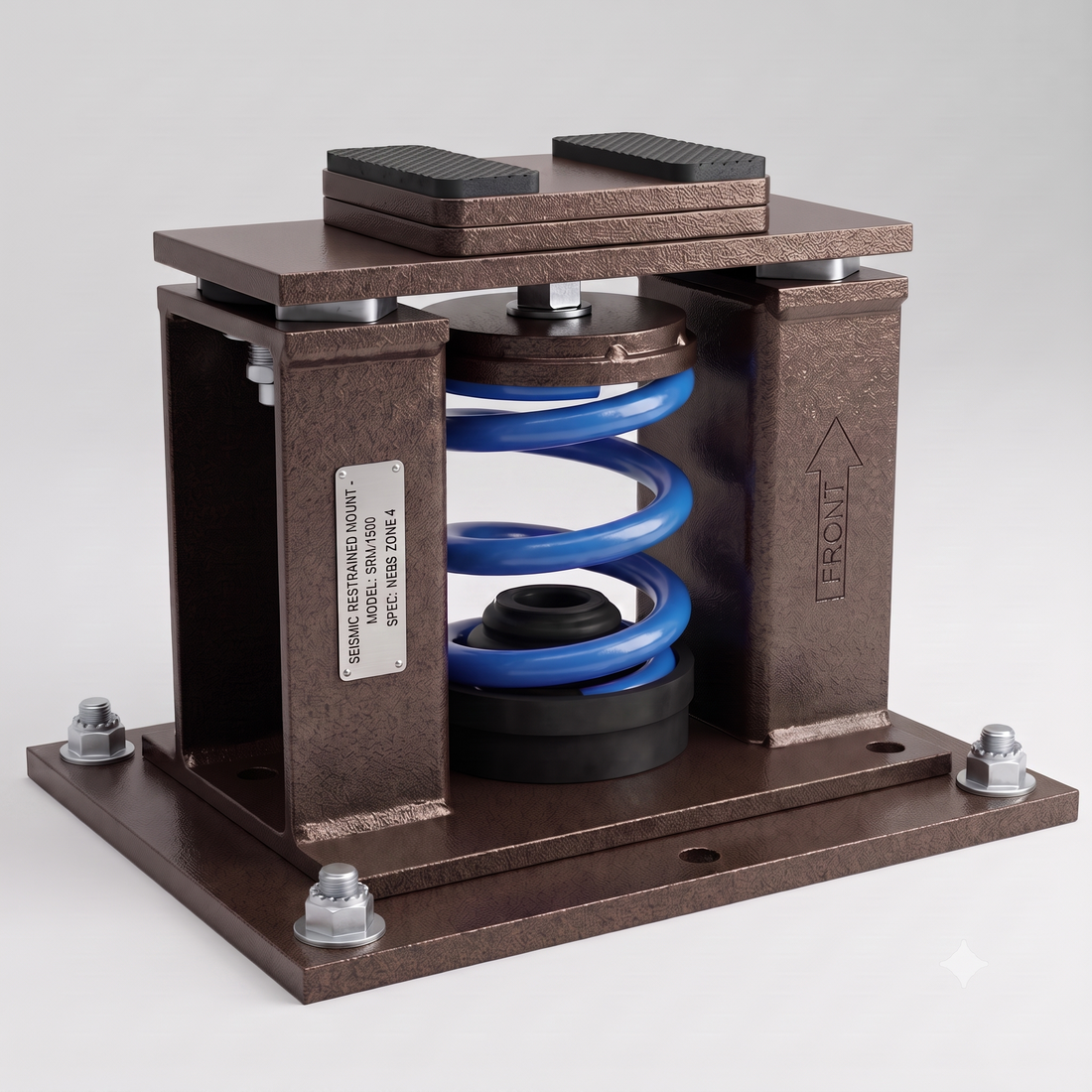
Spring-based isolation with an integrated restraint housing — spring, housing, clearances, attachments and structure evaluated together so isolation performance is maintained while restraint requirements are met.
Isolation and restraint for chillers, cooling equipment, air-handling systems and rooftop units.
Control of vibration transferred through bases, structural supports, piping and utility connections.
Protecting vibration-sensitive instruments, measurement systems and microscopy from facility-borne disturbances.
We discuss the equipment, the observed concern, operational requirements, constraints, schedule and the performance criteria the finished installation must meet.
We evaluate equipment data, mounting, supports, sources, transmission paths, structure and connected systems — including on-site vibration measurement where appropriate.
Calculations, equipment-support details, isolator and restraint specifications, CAD drawings, performance requirements and installation guidance.
Vendor coordination, technical review, installation oversight, field observation and verification appropriate to the project.
Have a specific facility or piece of equipment in mind? Our engineers are happy to talk it through.
Ask an EngineerVibration isolation reduces the transfer of vibration generated during normal equipment operation. Seismic restraint limits excessive equipment or system movement during a seismic event. Some applications require both, and the components must be coordinated so restraint does not interfere with normal isolation performance.
Pumps, compressors, fans, motors, chillers, air-handling and rooftop mechanical systems, industrial and production machinery, laboratory instruments, metrology systems, and other vibration-sensitive or vibration-producing equipment.
Yes. We assess existing equipment, mounting, supports, transmission paths and surrounding operations — which may include on-site inspection, vibration measurement, review of equipment data and structural-condition assessment. Retrofit feasibility is evaluated before an approach is recommended.
Rigidly connected services can create a parallel path that carries vibration around the isolator and into the structure. Connected services are reviewed alongside the mounting arrangement, and flexible connections or isolated supports may be recommended.
No. Maya Consulting works as an engineering consultant. Because we are not tied to a product line, components can be compared purely on their ability to meet the project's engineering requirements.
Yes. We are based in Hoboken, New Jersey and support facilities throughout NJ and the NY metropolitan area, including facility assessments, equipment inspections, vibration measurements, field coordination and verification.
Send us the equipment details and a photograph of the current installation. We'll tell you what can be determined from the information you already have — and what would require measurement on site.