Mechanical Engineering Consulting — New Jersey & NY Metro

Vibration Isolation & Seismic Restraint Systems

Site-specific engineering for equipment support, vibration control, and movement restraint — evaluated as one system, not selected from a catalog.

Maya Consulting Services evaluates your equipment, its supporting structure, connected piping and ductwork, and the operations around it, then develops the calculations, drawings, and specifications your team needs to implement a solution.

We are an engineering consultancy, not a manufacturer. We specify and coordinate components without being tied to a single product line.

Mechanical engineering drawings used to detail equipment supports, isolator placement, and restraint attachment points
The Engineering Problem

Choosing a Mount Is the Last Step, Not the First

Selecting a machinery mount or spring isolator is only one part of an effective equipment-support strategy. Equipment weight, operating frequency, expected deflection, structural stiffness, connected piping or ductwork, attachment conditions, available clearance, and surrounding operations can all affect how a system performs once it is installed.

When any of those conditions is assumed rather than evaluated, an isolator that looks correct on a submittal can underperform in the field — or short out entirely against a restraint, a rigid pipe connection, or an uneven support.

Depending on the application, our engineering support can help project teams:

  • Reduce the transmission of equipment-generated vibration
  • Protect sensitive processes, instruments, and nearby operations
  • Control excessive equipment movement under seismic loading
  • Coordinate isolators, restraints, frames, attachments, and structural supports
  • Address structure-borne noise created by mechanical equipment
  • Produce drawings and documentation that contractors can build from
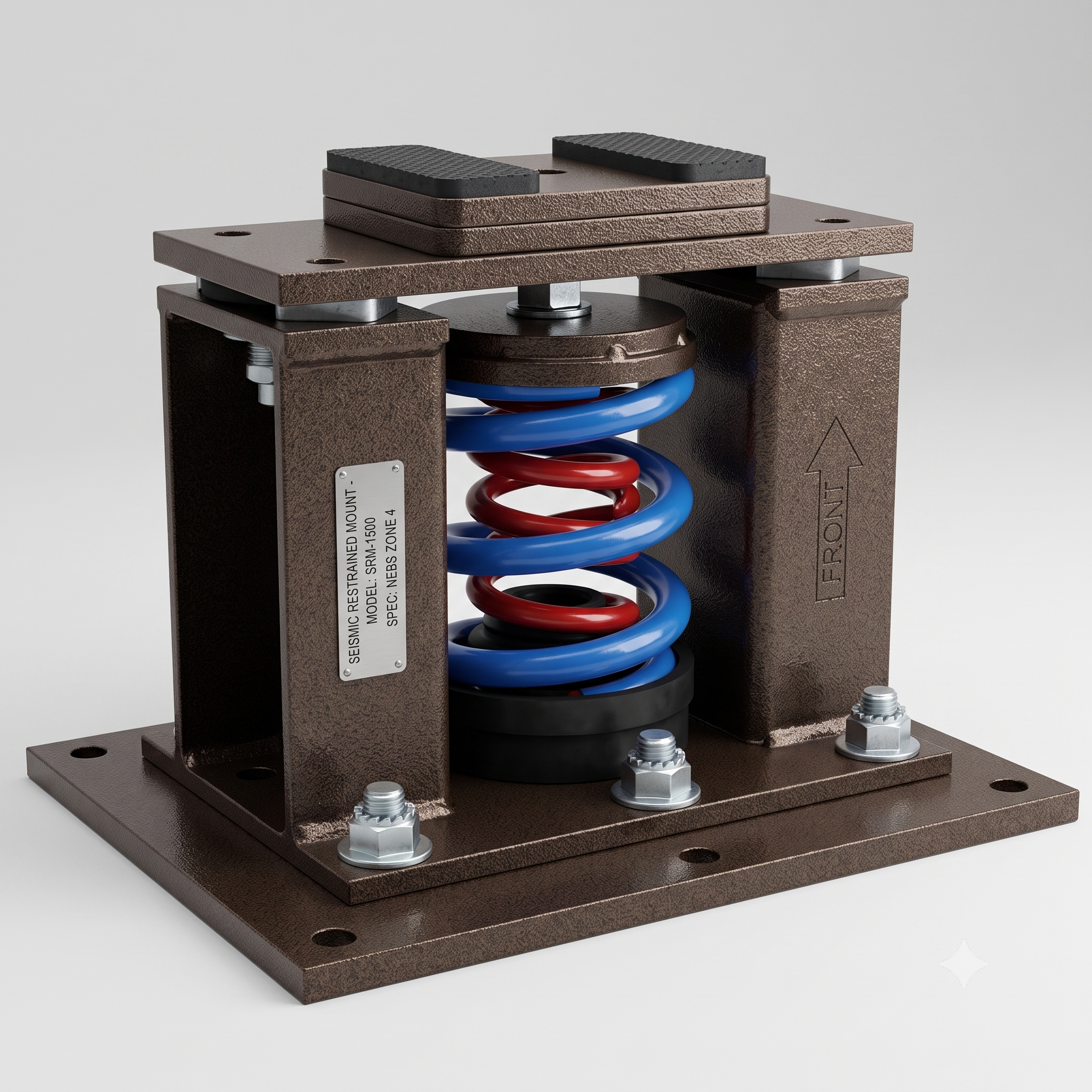
Seismic restrained spring mount showing the isolation spring, restraint housing, and steel base plate
A seismic restrained spring mount: spring isolation and movement restraint in one assembly.
Isolation vs. Restraint

Two Different Functions. One Coordinated System.

Vibration isolation and seismic restraint address different operating conditions. In many applications, the two must be designed to work together — and they can work against each other when they are not.

Vibration Isolation

Isolation reduces the transfer of operating vibration between machinery, its supports, the building structure, floors, piping, ductwork, and nearby sensitive systems.

The appropriate approach depends on operating speed, forcing frequency, weight distribution, center of gravity, target isolation efficiency, the stiffness of the supporting structure, and the sensitivity of surrounding spaces.

Seismic Restraint

Restraint limits excessive movement of equipment and nonstructural systems during a seismic event. Restraints, anchors, clearances, attachments, and supporting structures are coordinated around the anticipated loads and the applicable project requirements.

A restraint system should limit potentially damaging movement without interfering with the isolator during normal equipment operation.

When Both Functions Are Required

Some equipment must stay isolated during normal operation while also being restrained against excessive movement. Seismic restrained spring mounts are one assembly intended to address both requirements at once.

Because the isolator, restraint housing, attachment points, supporting structure, connected utilities, and required clearances all interact, they are best evaluated as a single coordinated system rather than as separately specified parts.

Engineering Solutions

Isolation and Restraint Approaches We Evaluate

We help project teams evaluate mounting conditions, define performance requirements, select an appropriate isolation or restraint approach, and produce the documentation needed to implement it.

Antivibration Machinery Mounts & Damping

Antivibration mounts and isolation pads reduce the transfer of vibration between operating machinery and its supporting structure. Damping treatments serve a related but distinct function — dissipating vibrational energy and reducing excessive resonant response.

We evaluate the vibration source, equipment characteristics, support conditions, transmission paths, and surrounding operations to determine whether isolation, damping, or a combination is appropriate.
Spring Vibration Isolators

Spring isolators may be appropriate for heavy mechanical equipment and for applications where low-frequency vibration requires more static deflection than a rigid or elastomeric mount can provide.

We support selection based on equipment loads, operating frequencies, required deflection, support conditions, stability, installation constraints, and the project's performance objectives.

Seismic Restrained Spring Mounts

These assemblies combine spring-based isolation with an integrated housing designed to limit excessive equipment movement.

Proper selection requires more than matching a mount to an equipment weight. The spring, housing, load distribution, clearances, attachment conditions, connected utilities, and supporting structure are evaluated together so that normal isolation performance is maintained while restraint requirements are addressed.

Applications

Equipment and Installations We Evaluate

Requirements vary with equipment behavior, structural support, facility conditions, and the sensitivity of surrounding operations. Recommendations are developed around the specific application rather than a standard mounting detail.

HVAC and Building Mechanical Equipment

Isolation and restraint requirements for chillers, cooling equipment, air-handling systems, rooftop units, and other building mechanical equipment.

Pumps, Compressors, Fans and Motors

Vibration transferred through equipment bases, structural supports, piping connections, utility connections, and adjacent systems.

Industrial and Production Machinery

Mounting and support strategies for machinery that generates dynamic, rotating, reciprocating, or repetitive operating forces.

Laboratory, Metrology and Research Equipment

Protecting vibration-sensitive instruments, measurement systems, microscopy, and research processes from disturbances transmitted through the facility.

Rooftop and Floor-Mounted Installations

Coordinating equipment isolation, structural support, anchorage, movement control, and connected building systems.

Piping, Ductwork and Connected Infrastructure

Supports and restraints for connected systems where vibration transmission, movement, attachment conditions, or seismic stability are project considerations.

Our Process

From Site Conditions to an Implementable Solution

Every project starts with the equipment, the facility, the structural conditions, and the performance requirements — then moves through evaluation, engineering, and implementation support.

  1. Define the Requirements

    We discuss the equipment, the observed vibration or movement concern, operational requirements, facility constraints, project schedule, and the performance criteria the finished installation needs to meet.

  2. Assess the Site and Equipment

    We evaluate equipment data, mounting conditions, existing supports, vibration sources, transmission paths, structural conditions, connected systems, and surrounding operations. Where appropriate, this includes on-site vibration measurements and evaluation of ambient conditions that cannot be understood from submittals or building drawings alone.

  3. Engineer and Document the Solution

    We evaluate operating frequencies, static and dynamic loads, isolation objectives, expected movement, structural requirements, and available installation space. The resulting package may include calculations, equipment-support details, isolator and restraint specifications, CAD drawings, performance requirements, and installation guidance.

  4. Support Implementation and Verification

    We can assist with vendor coordination, technical review, installation oversight, field observations, and verification appropriate to the project — which helps catch installation conditions that would otherwise compromise the intended performance.

Technical Capabilities

Engineering Support Across the Complete Application

Performance depends on far more than an individual mount. Equipment characteristics, structural stiffness, load distribution, frame design, attachment details, connected utilities, installation quality, and the surrounding environment all affect the result.

Depending on project scope, we can support:

  • Site and equipment-condition assessments
  • Vibration measurement and analysis
  • Source and transmission-path evaluation
  • Operating-frequency analysis
  • Isolator, machinery mount, and damper selection
  • Static and dynamic load evaluation
  • Spring-deflection and load-distribution review
  • Seismic load and restraint evaluation
  • Structural frame and equipment-support design
  • Attachment and installation detailing
  • CAD drawings and three-dimensional models
  • Technical reports and calculation packages
  • Performance specifications and installation requirements
  • Vendor and contractor coordination
  • Field inspection and installation support
  • Post-installation performance verification
Working Together

What You Provide, and What You May Receive

Scope varies with the equipment and the facility. The lists below describe what typically starts a project and what an engineering package may contain, subject to evaluation.

Project Information to Provide

The more of this you can share up front, the faster we can tell you whether an on-site assessment is warranted:

  • Equipment type, manufacturer, and model
  • Equipment weight and operating speed or frequency
  • Existing mounting and support condition
  • Available drawings, submittals, or cut sheets
  • Photographs of the installation and surroundings
  • Facility location and the observed vibration concern
  • Connected piping, ductwork, and utility connections
  • Installation constraints and desired schedule

What an Engineering Package May Include

Deliverables are defined by project scope and are confirmed before work begins:

  • Existing-condition and equipment-mounting assessment
  • Vibration measurements, where the application warrants them
  • Engineering calculations and load evaluation
  • Isolator, mount, and restraint requirements
  • CAD drawings and equipment-support details
  • Structural-support and attachment detailing
  • Performance specifications and installation requirements
  • Vendor coordination and field observation
  • Performance-verification recommendations

Not Sure Whether You Need an Assessment?

Send us the equipment details and a photograph of the current installation. We will tell you what can be determined from the information you already have, and what would require measurement on site.

Our Approach

Engineering First, Not Product First

A catalog mount cannot account for the specific equipment, structure, utilities, clearances, operating frequencies, and performance requirements at your facility. We start from the engineering problem rather than a predetermined product, which keeps you free to compare suitable manufacturers, components, and installation methods on the merits.

Site-Specific Evaluation

Recommendations are developed around your equipment, supporting structure, surrounding operations, and measurable project requirements.

Coordinated System Design

Mounts, isolators, restraints, frames, anchors, and connected utilities are treated as parts of one equipment-support system.

Product-Agnostic Selection

Components are evaluated on their ability to meet the project's engineering requirements rather than on an association with a particular product line.

Implementation Support

Documentation, vendor coordination, installation guidance, and verification carry the design intent through to the finished installation.

Industries

Facilities Where Equipment Stability Matters

We work with facilities where vibration control, seismic restraint, structural support, and stable operating conditions affect the outcome of the work being done inside them.

Service Area

Engineering Support from Hoboken, New Jersey

Projects in this region often involve dense urban sites, nearby traffic or transit activity, construction vibration, limited installation space, rooftop mechanical equipment, sensitive neighboring occupancies, and differing project requirements across New Jersey and New York jurisdictions.

Those conditions are exactly why a site-specific assessment matters. An approach that works for equipment in an isolated industrial building may be inappropriate for a laboratory, a mixed-use property, or a rooftop installation in a densely developed block.

Related Services

Related Engineering Services

FAQ

Common Questions

What is the difference between vibration isolation and seismic restraint?

Vibration isolation reduces the transfer of vibration generated during normal equipment operation. Seismic restraint limits excessive equipment or system movement during a seismic event.

Some applications require both. In those cases the isolation and restraint components must be coordinated so that the restraint does not interfere with normal isolation performance.

What types of equipment can be evaluated?

Pumps, compressors, fans, motors, chillers, air-handling equipment, rooftop mechanical systems, industrial machinery, production equipment, laboratory instruments, metrology systems, and other vibration-sensitive or vibration-producing equipment.

The appropriate approach depends on the equipment, operating frequency, load distribution, supporting structure, connected systems, and required performance.

Can existing equipment be retrofitted, and can existing vibration problems be diagnosed?

Yes. We can assess existing equipment, mounting conditions, support structures, transmission paths, and surrounding operations. Depending on the application, this may include an on-site inspection, vibration measurements, review of equipment data, and structural-condition assessment.

Retrofit feasibility depends on equipment access, available clearance, existing supports, utility connections, load distribution, structural capacity, and allowable movement. Those conditions are evaluated before a retrofit approach is recommended.

How do piping, ductwork, and utility connections affect isolation performance?

Rigidly connected piping, ductwork, conduit, and other utilities can create a parallel transmission path that carries vibration around the isolator and into the structure. When that happens, a correctly sized isolator can still deliver disappointing results.

Connected services are therefore reviewed alongside the mounting arrangement, and flexible connections or isolated supports may be recommended depending on the installation.

When are on-site vibration measurements needed?

Measurements are most useful when the source or the transmission path is uncertain, when a complaint concerns a sensitive neighboring space, or when an existing installation is underperforming for reasons that equipment submittals cannot explain.

For new installations with well-documented equipment, an evaluation can often begin from drawings and equipment data. We will tell you which situation applies before proposing site work.

What information is needed to begin an assessment?

Equipment type, manufacturer and model, weight, operating speed or frequency, the existing mounting condition, any available drawings or submittals, photographs of the installation, the facility location, the observed concern, and details of connected piping or ductwork.

Partial information is still a useful starting point — it usually tells us what else needs to be gathered.

What deliverables can Maya provide?

Documentation appropriate to the project, which may include engineering calculations, CAD drawings, equipment-support details, isolator or mount specifications, restraint details, performance requirements, and installation guidance.

Deliverables are defined by project scope, equipment, facility conditions, and implementation needs, and are confirmed before work begins.

Does Maya manufacture or sell vibration isolators?

No. Maya Consulting Services works as an engineering consultant. Our role is to evaluate the application, define performance requirements, develop the engineering solution, and support the selection and implementation of appropriate components.

Because we are not tied to a product line, components can be compared on their ability to meet the project requirements. Product sourcing and installation responsibilities are coordinated according to the needs of each project.

Can Maya coordinate with equipment vendors and contractors?

Yes. Vendor coordination, technical review of proposed components, installation guidance, and field observation can be included in the scope.

Early coordination is generally more effective than late review, because attachment points, clearances, and structural support are easier to adjust before equipment is set.

Does Maya support projects in New Jersey and the New York metro area?

Yes. We are based in Hoboken, New Jersey and support facilities throughout New Jersey and the New York metropolitan area.

On-site services may include facility assessments, equipment inspections, vibration measurements, field coordination, installation observation, and performance-verification support, depending on the project.

Discuss Your Equipment-Support Requirements

Whether you are troubleshooting excessive machinery vibration, installing sensitive equipment, evaluating spring isolators, coordinating seismic restraints, or developing a new equipment-support system, we can help you determine the appropriate engineering path forward.